





Palletizer Performance Tuning
Palletizer Performance Tuning: Enhancing Efficiency in Automated Material Handling Palletizers are the backbone of modern distribution centers, automating the labor-intensive task of stacking products onto pallets for storage and shipping. However, even advanced systems can underperform without regular tuning—leading to bottlenecks, product damage, and unnecessary operational costs. Performance tuning is a systematic process of optimizing mechanical, software, and sensory components to maximize throughput, reduce errors, and ensure consistent, safe operation. Mechanical adjustments form the foundation of tuning. For robotic palletizers, this includes fine-tuning gripper pressure: too much force risks crushing fragile items, while too little leads to product slippage and drops. Conveyor speed synchronization is another critical area—misalignment between infeed conveyors and the palletizer’s cycle time can cause backups or underutilization. Optimizing robotic arm trajectories to eliminate redundant movements (e.g., reducing the distance between product pick-up and pallet placement) can cut cycle time by 10–15% in some cases. Software optimization plays an equally vital role. Pallet pattern algorithms are adjusted to maximize load density—balancing product stability with space utilization to fit more units per pallet. Motion planning software is refined to create smoother, faster paths for robotic arms, while error-handling logic is updated to reduce false stops (e.g., adjusting sensor thresholds to ignore minor, non-critical deviations). For example, a system previously stopping due to small product position variations might be tuned to adapt to offsets, keeping operations running without interruption. Sensor calibration is essential for precision. Vision systems, which guide robotic arms to pick and place products, require regular calibration to maintain accuracy—especially as lighting conditions or packaging change. Proximity sensors are adjusted to prevent collisions between the arm and pallets or equipment, while weight sensors ensure loads are balanced to avoid tipping during transport. The tuning process starts with data collection: IoT sensors track cycle time, error rates, product damage, and energy consumption. Root cause analysis identifies bottlenecks—for instance, slow cycle time might stem from an unoptimized arm path or misaligned gripper. Iterative testing follows: small adjustments are made, and their impact is measured to avoid unintended consequences. Continuous monitoring ensures performance remains optimal as components wear or demands shift. The outcomes are tangible: increased throughput (often 20–30%), reduced product damage (from 5% to <1% in many cases), lower downtime, and improved energy efficiency. For distribution centers, this translates to higher operational efficiency, lower costs, and better customer satisfaction—orders are fulfilled faster with fewer damaged goods. In conclusion, palletizer tuning is a continuous improvement process. By focusing on mechanical, software, and sensory optimization, organizations unlock their automated systems’ full potential, meeting modern supply chain demands effectively.
Products
Category:
-
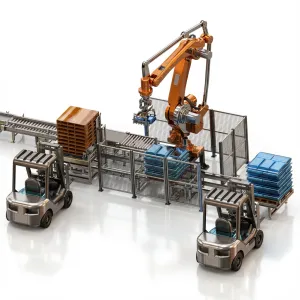
High-Performance Robot Palletizer
Category: Palletizing SystemBrowse number: 346Number:Release time: 2026-01-16 09:59:02High-performance robotic palletizer, always provide customers with customized product palletizing solutions by support of ChengYi's advanced technology. We use different robot models and grippers according to customer specified needs. Selection and editingof pallet patterns can be easily performed via the touch screen. Responsive remote service helps customers resolve issues such asprogram upgrades, troubleshooting or adding new pallet pattern program without having to send an enaineer to the customer site.
News
Category:
-
[News]Case Packing Equipment for Food Cosmetic and Industrial Prod...
2026-07-02 06:40:56 -
[News]Cost Effective FFS Packaging Systems for Small Businesses
2026-08-24 02:18:55
Case
Category:
No search results found!
Video
Category:
No search results found!
Download
Category:
No search results found!
Job
Category:
No search results found!
Featured Products
No search results found!


