





Bagging Palletizing Automation
Bagging palletizing automation is a transformative industrial solution that integrates mechanical precision, sensor technology, and intelligent software to streamline the packaging and stacking of bulk materials into pallets. This system replaces labor-intensive manual tasks, enhancing efficiency, consistency, and safety across diverse sectors. The process begins with automated bagging: bulk materials—from agricultural grains and construction cement to chemical powders and food ingredients—are measured precisely, filled into bags, sealed, and labeled. Advanced bagging machines use weight sensors to ensure accurate fill volumes, while heat sealers or stitching mechanisms secure bags to prevent spillage. Labeling systems apply barcodes or QR codes with batch numbers, expiration dates, and product details, enabling end-to-end traceability. Once bagged, products move via conveyor systems to the palletizing station. Robotic arms, equipped with material-specific grippers (for fabric or plastic bags), pick up bags and place them onto pallets in pre-programmed patterns—block, column, or interlocking stacks—to maximize stability and space utilization. Vision sensors guide robots to adjust for minor bag variations, ensuring consistent stacking even with irregular loads. For heavy-duty applications, gantry systems use overhead rails to handle high volumes, moving bags across large areas with precision. Core components include programmable logic controllers (PLCs) that orchestrate workflows, human-machine interfaces (HMIs) for real-time monitoring, and sensors that detect bag integrity, weight, and position. These elements minimize downtime and reduce errors. The benefits are significant: automated systems handle hundreds of bags per hour, outpacing manual labor. They eliminate workplace injuries from heavy lifting and repetitive motions, improving safety. Cost savings stem from reduced labor expenses, lower product waste (due to precise filling), and optimized pallet space that cuts storage and shipping costs. This technology is widely used in agriculture (fertilizer, grain), construction (cement, sand), chemicals (industrial powders), and food processing (flour, sugar). Emerging trends include IoT integration for predictive maintenance—using sensor data to anticipate machine failures—and AI-driven stacking optimization for better space efficiency. Collaborative robots (cobots) also work alongside humans to handle flexible tasks, enhancing adaptability. In short, bagging palletizing automation is an essential investment for businesses seeking to boost productivity, safety, and competitiveness in a fast-paced global market. It transforms end-to-end logistics, turning manual, error-prone processes into streamlined, data-driven operations.
Products
Category:
-
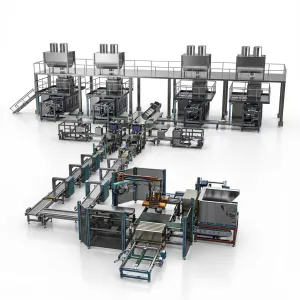
Fully Automatic Bagging, Case Packing and Palletizing Line
Category: Case Packing SystemBrowse number: 360Number:Release time: 2026-01-16 10:01:29The fully automatic packaging line integrated with VFFSbagger, carton erector, gravity case packer, case vibrator,-check weigher, case sealer, robotic palletizor, Automaticpallet dispenser etc. Widely used in food and non-food indus-tries, such as rice, sugar, grains, pasta, snack foods, detergentpowder, etc.
News
Category:
-
[News]Customizable Vertical Packaging Solutions for Unique Product...
2026-08-27 02:27:52
Case
Category:
No search results found!
Video
Category:
No search results found!
Download
Category:
No search results found!
Job
Category:
No search results found!
Featured Products
No search results found!


